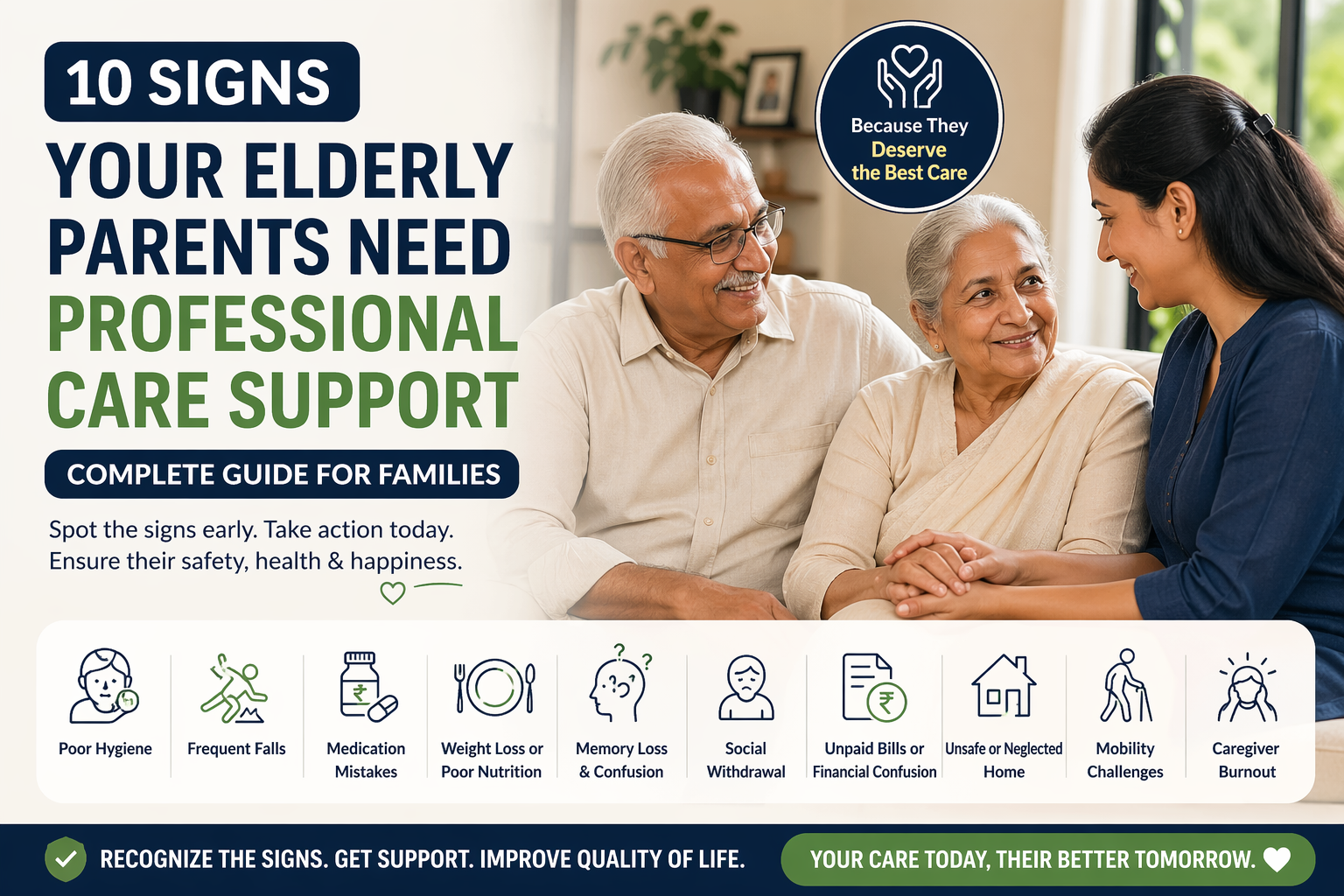
The most common signs elderly need care include poor hygiene, memory loss, frequent falls, medication mistakes, weight loss, and social withdrawal. If multiple signs appear together, it’s time to consider hiring a caregiver to ensure safety and improve quality of life.
You spoke to your parent last Sunday. They said everything is fine. But something felt off — their voice sounded distant, they couldn’t remember what they had for lunch, and they brushed off your concern with a familiar “don’t worry about me.”
That quiet unease you’re feeling? It matters. And you’re not alone.
For millions of families — especially those living away from aging parents — recognizing the signs elderly need care is one of the hardest challenges they’ll face. The warning signs are rarely dramatic. They creep in slowly, disguised as “just getting older,” until a fall, a medical emergency, or a worried neighbor forces the conversation no one wanted to have.
This guide is different from the generic checklists you’ll find elsewhere. We’ll walk you through the 10 most critical warning signs, explain why families miss them, tell you exactly when to act, and give you practical steps to start the conversation with your parents — with compassion, not conflict.
If you’re reading this, you’re already being a responsible, caring family member. Let’s make sure that care comes early enough to matter.
Why Most Families Miss the Signs Elderly Need Care
Before we get to the signs themselves, it’s important to understand why so many families only recognize them in hindsight.
Seniors actively hide their struggles. Independence is deeply tied to dignity for most elderly people. Admitting difficulty — whether it’s forgetting to take medication or struggling to climb stairs — feels like giving something up. So they minimize, deflect, and reassure. “I’m fine” is often the most well-practiced sentence in their vocabulary.
Infrequent visits create blind spots. For families living in different cities — or NRI families abroad — visits happen once or twice a year. When you see someone every day, gradual decline is invisible. When you see them after six months, the contrast can be alarming. But by then, the early window for intervention has often passed.
Small signs get filed under “normal aging.” Moving a little slower, forgetting a name, eating less — individually, these seem unremarkable. But a cluster of these changes over weeks or months is a signal, not a coincidence.
Understanding these dynamics is the first step. Here are the signs you should never ignore.
10 Critical Signs Your Elderly Parents Need Professional Care
Quick Checklist: Signs Your Parents May Need Care✔Missing or mismanaged medications✔Frequent falls or unexplained injuries✔Poor personal hygiene✔Social withdrawal or emotional changes✔Unexplained weight loss✔Financial confusion or unpaid bills✔Unsafe or neglected living environment✔Memory loss or confusion✔Mobility challenges✔Family caregiver burnout👉 If you’re noticing two or more of these signs, it may be time to consider professional care support before a crisis occurs.
If you’re checking two or more of these boxes, keep reading — and don’t wait.
| Sign | What It Indicates |
|---|---|
| Poor personal hygiene | Mobility limitations or mental health decline |
| Frequent falls or injuries | Serious safety risk at home |
| Memory loss or confusion | Possible cognitive decline or early dementia |
| Unexplained weight loss | Nutritional neglect or emotional withdrawal |
| Social isolation | Emotional health decline and depression risk |
| Missed medications | Cognitive or physical management difficulties |
| Financial confusion | Cognitive decline and vulnerability to scams |
| Cluttered or neglected home | Inability to manage daily tasks independently |
| Mobility challenges | Physical deterioration and fall risk |
| Caregiver burnout | Professional support is urgently needed |
1. Decline in Personal Hygiene
One of the earliest and most telling signs elderly need care is a change in how your parent takes care of themselves. You might notice they’re wearing the same clothes for several days in a row, their hair is unwashed, or there’s an unfamiliar odor when you visit or even during a video call.
This isn’t about vanity. Personal hygiene decline often points to something deeper — reduced mobility that makes bathing painful or dangerous, depression that saps motivation, or early cognitive changes that make routine tasks feel overwhelming.
Action Tip: Don’t address it with embarrassment or criticism. Schedule regular check-ins and gently offer help. If the issue is physical, a home care professional can assist with bathing and grooming as part of a structured daily routine.
2. Unsafe or Neglected Living Environment
A messy home is often one of the earliest signs elderly need care. When you visit, look beyond general tidiness. Check for stacks of unopened mail and unpaid bills, spoiled food in the refrigerator, clutter that creates tripping hazards, or a home that smells of mold or garbage.
These aren’t housekeeping failures — they’re evidence that your parent is struggling to manage daily tasks that were once effortless. A neglected living environment also dramatically raises the risk of infections, accidents, and falls.
Action Tip: During your next visit or video call, do a gentle walkthrough. Ask if they need help with household tasks. A professional caregiver can assist with light housekeeping and help maintain a safe, clean environment.
3. Medication Mismanagement
Medication errors are among the most dangerous and overlooked risks for elderly individuals. This includes missing doses, taking double doses by mistake, confusing different medications, or abandoning a prescription because it feels “unnecessary.”
For seniors managing multiple chronic conditions — diabetes, hypertension, heart disease — improper medication use can trigger serious medical crises quickly and silently.
Action Tip: Use a weekly pill organizer as an immediate step. Better yet, arrange for a caregiver to provide daily medication reminders and supervision. If you’re managing this remotely, automatic dispensers and medication management apps designed for elderly users are worth exploring.
4. Sudden Weight Loss or Poor Nutrition
If your parent looks noticeably thinner since your last visit, or if the refrigerator is nearly empty every time you call, take it seriously. Unexplained weight loss and poor nutrition signal a serious decline in their ability — or desire — to feed themselves properly.
The causes can be physical (difficulty cooking, dental pain, reduced sense of taste), cognitive (forgetting to eat), or emotional (depression, grief, loneliness that kills appetite). The consequences are severe: weakened immunity, muscle loss, fatigue, and faster deterioration of existing health conditions.
There is also an emotional dimension here that is easy to miss. An elder who no longer cooks may be someone who has quietly lost their sense of purpose and routine — and that is as much a health crisis as any physical symptom.
Action Tip: Arrange for nutritious meal delivery or a caregiver who can assist with meal preparation. Make meals a shared, social experience whenever possible.
5. Memory Loss and Confusion
Forgetting where they placed their glasses is normal. Forgetting their grandchild’s name, repeating the same question three times in one conversation, or getting confused about what day or year it is — these are critical senior health warning signs that demand attention.
Memory loss that disrupts daily life is often an early indicator of dementia or Alzheimer’s disease. The earlier these conditions are identified, the more effective the management strategies. Waiting until the confusion becomes severe significantly limits the options available.
Action Tip: Consult a geriatric specialist as soon as you notice a pattern of memory lapses. Early diagnosis opens doors to medication, therapy, and care planning that can meaningfully improve quality of life.
6. Frequent Falls or Unexplained Injuries
According to global health estimates, falls are one of the leading causes of serious injury among adults over 65 — and one of the most urgent signs elderly need care at home. If your parent has fallen more than once in recent months, or if you notice unexplained bruises, cuts, or hesitation when they move around, this requires immediate attention.
Many elderly people don’t report falls out of fear — fear of being seen as incapable, of losing their independence, of worrying their family. This silence is dangerous.
Action Tip: Assess the home for fall hazards — loose rugs, poor lighting, lack of grab bars in the bathroom. A professional caregiver can provide physical support and mobility assistance that dramatically reduces fall risk.
7. Mobility Challenges
Beyond falls, watch for a general decline in how your parent moves. Are they struggling to get up from a chair? Shuffling instead of walking? Holding onto walls for support? Avoiding stairs they used to climb easily?
Reduced mobility creates a cascade of other problems. Limited movement leads to muscle atrophy, circulation issues, pressure sores, and increased dependence for basic activities like bathing, cooking, and getting to appointments.
Action Tip: A physiotherapist can design a safe movement plan. A caregiver can provide daily mobility assistance and ensure your parent is moving safely and consistently.
8. Social Withdrawal and Emotional Changes
Studies show that social isolation significantly increases health risks in older adults — including faster cognitive decline, depression, and a measurably shorter lifespan. When a once-social parent stops calling friends, skips gatherings they used to love, becomes unusually irritable or tearful, or spends most of the day alone, it’s a red flag, not a phase.
Loneliness is not a soft problem. It is a medical one.
Action Tip: Regular companionship — from family, community, or a trained caregiver — is not optional. It is healthcare. Professional care support can provide consistent social engagement as part of a structured daily routine.
9. Financial Confusion or Unpaid Bills
If you notice overdue utility bills, unopened bank statements, or your parent mentioning forgotten payments, pay close attention. Financial confusion is both a symptom of cognitive decline and a danger in its own right.
Elderly individuals experiencing cognitive changes become prime targets for financial scams — fraudulent callers, fake charity appeals, and predatory schemes specifically designed to exploit vulnerable seniors.
Action Tip: Help set up automatic bill payments and involve a trusted family member in financial oversight. If scam risk is present, speak with a legal advisor about protective arrangements.
10. Caregiver Burnout (The Hidden but Critical Sign)
This one rarely appears on standard lists — but it may be the most important sign of all.
If you or another family member has been the primary caregiver, ask yourself honestly: Are you exhausted? Are you snapping at your parent or feeling quietly resentful? Are you constantly anxious about their safety even when you’re not with them? Have your own health, work, and relationships started to suffer?
Caregiver burnout is not a personal failure. It is a structural problem — one person or family cannot safely provide the level of care a trained professional team can. When a caregiver is burned out, the quality of care suffers for both sides. The caregiver’s health declines. The elder’s needs go unmet. Everyone loses.
Caregiver burnout is a clear sign that professional support is no longer optional — it is necessary.
Noticing 2–3 of these signs together? Don’t wait for a crisis. 👉 Explore Professional Home Care Options for Your Parents →
Special Challenges for NRI Families: Managing Elderly Care from Abroad
For Non-Resident Indians and families living in other cities, spotting the signs elderly need care comes with an extra layer of difficulty — and an extra layer of urgency.
Limited visibility is the core problem. When you’re thousands of miles away, your primary windows into your parent’s daily life are phone calls and occasional visits. But phone calls rarely reveal a cluttered home, a near-empty refrigerator, or the way your parent hesitates before standing up. And visits happen too infrequently to catch gradual changes in real time.
Dependence on calls creates false reassurance. Most elderly parents will not worry their children who are far away. They have spent decades being the caregiver in the family, not the one receiving care. Over a phone call, they will sound fine even when they are not.
When something does go wrong, response time is a problem. A fall, a missed medication, a sudden health event — when you are hours away by flight, there is no rushing over. This is precisely why having a professional care support system in place before a crisis is not just convenient — it is responsible planning.
If you are an NRI or a family living away from aging parents, a reliable local care partner gives you something no amount of worrying can: consistent, professional eyes on your parents every single day.
👉 Learn How We Support NRI Families with Remote Care Management →
When to Hire a Caregiver: A Clear Decision Guide
Knowing the signs elderly need care is only half the equation. The other half is knowing when to act on them.
Act immediately if two or three of the above signs are occurring together. A cluster of signs indicates a pattern of decline, not isolated incidents.
Seek urgent care if safety is at risk — frequent falls, medication mismanagement, or significant memory confusion all require immediate professional intervention.
It’s already time if you feel constant, low-grade worry about your parent’s wellbeing. That persistent anxiety is your instincts telling you something your logic is still debating.
Consider hiring a caregiver if you’re seeing any of these:
Signs That Additional Care May Be Needed
Recognizing these signs early can help ensure timely support and improved well-being.
- ❗ Missed medications regularly
- ⚠️ One or more falls in the past few months
- 👤 Increasing social isolation
- 🧼 Noticeable decline in personal hygiene
- 💳 Signs of financial confusion or unpaid bills
- ⚖️ Unexplained weight loss
- 💬 Caregiver burnout in yourself or another family member
What Happens If You Ignore These Signs?
The instinct to wait — to give it more time, to hope things stabilize — is understandable. But the cost of waiting is real.
Unaddressed signs elderly need care lead to preventable medical emergencies: falls that cause fractures, missed medications that trigger cardiac events, malnutrition that weakens the immune system. These emergencies are more traumatic, more expensive, and more damaging than early, proactive care would ever have been.
They also accelerate health decline. The body and mind deteriorate faster without proper support, nutrition, social engagement, and medical oversight. Early professional care doesn’t just manage problems — it actively slows the progression of many age-related conditions.
There is a significant emotional cost too: the guilt, grief, and regret that families carry when they realize the signs were there and they waited too long. And finally, late intervention is dramatically more expensive. A medical crisis requiring hospitalization or intensive rehabilitation costs far more than months of preventive home care.
Early action is not just more compassionate. It is more practical.
Best Care Options When You Notice Signs Elderly Need Care
Every family’s situation is different. Here are the primary options to consider:
Home care is ideal for seniors who want to remain in familiar surroundings. A trained caregiver assists with personal hygiene, meals, medication, mobility, and companionship. This is often the most comfortable and dignity-preserving option.
👉 Explore Home Care Services for Your Elderly Parents →
Nursing care provides medical-level support at home for seniors with complex health needs — wound care, injections, physiotherapy, or post-hospitalization recovery.
Assisted living facilities offer a structured community environment with round-the-clock support, social programming, and medical oversight for seniors who need more comprehensive care than home visits can provide.
Emergency support services provide immediate, short-term care during a health crisis, caregiver absence, or sudden change in condition.
👉 Not Sure Which Option Is Right? Get a Free Care Consultation →
How to Talk to Your Parents About Getting Help
This is the conversation most families dread — and the reason many of the signs elderly need care go unaddressed for too long.
Don’t lead with authority. Telling your parent what they need to do, or presenting care as something being done to them, will almost always trigger resistance.
Lead with love and specific observation. Instead of “You need a caregiver,” try “I noticed the fridge was empty last time, and I’ve been worried. Can we talk about how to make things easier for you?” Specific observations are harder to dismiss than general concerns.
Frame it around safety, not weakness. Professional care is what allows your parent to remain independent, in their own home, for as long as possible. That framing changes everything.
Include them in every decision. Ask what kind of help they’d feel comfortable with. Give them real choices. When people feel ownership over a decision, they’re far more likely to accept it.
Be patient. This conversation rarely resolves in one sitting. Plant the seed, keep the channel open, and return to it gently.
Why Early Care Improves Quality of Life
There’s a common misconception that professional care signals the beginning of the end — a loss of independence. The evidence shows the opposite.
Seniors who receive early, consistent professional support maintain their independence longer. With the right assistance for tasks that have become difficult, they continue managing the tasks they can — preserving autonomy, routine, and dignity.
Early care produces measurably better health outcomes: better nutrition, medication adherence, early detection of new health issues, and more consistent physical activity all lead to fewer hospitalizations and slower disease progression.
Structured daily care, social engagement, and meaningful companionship are powerful protectors of cognitive and emotional wellbeing. They reduce isolation, combat depression, and give elders a sense of purpose and routine.
And for the family, early professional support brings something invaluable: peace of mind. The constant background worry — Is she okay? Did he fall? Did she take her medication? — quiets when you know a trained professional is part of your parent’s daily life.
Frequently Asked Questions: Signs Elderly Need Care
What are the early signs elderly need care? The earliest signs elderly need care are often subtle: a decline in personal hygiene, a messier-than-usual home, missed medications, reduced appetite, and social withdrawal. These signs tend to appear gradually and are easy to dismiss individually — which is why it’s important to look for patterns rather than isolated incidents.
When should I hire a caregiver for my elderly parent? You should consider hiring a caregiver when two or more warning signs appear together, when your parent’s safety is at risk due to falls, medication errors, or confusion, or when you or another family member are experiencing caregiver burnout. You don’t need to wait for a crisis — early support is always more effective than emergency response.
Is memory loss always a sign of serious illness? Not always. Occasional forgetfulness — misplacing items, momentarily forgetting a name — is a normal part of aging. However, memory loss that disrupts daily life is a serious warning sign that warrants a medical evaluation. Early assessment is critical for conditions like dementia and Alzheimer’s.
Can elderly care be provided at home? Yes — and for most families, home care is the preferred option. Professional caregivers can provide personal hygiene assistance, meal preparation, medication management, mobility support, companionship, and nursing care for complex medical needs — all within the comfort of your parent’s own home.
👉 Explore Our Home Care Services →
How do NRI families manage elderly care from abroad? NRI families face unique challenges because they cannot monitor daily changes in person. The most effective approach is to engage a trusted local professional care service that provides regular updates, structured daily support, and emergency response capability — giving families abroad consistent visibility and peace of mind without depending solely on phone calls or infrequent visits.
Conclusion
Recognizing the signs elderly need care is not an act of alarm — it’s an act of love. It means you’re paying attention when it counts most.
The signs are rarely dramatic. They’re quiet, gradual, and easy to explain away. But they are real, and they are telling you something important. And the families who act early — before a crisis forces their hand — are the ones who avoid the deepest regrets.
You don’t need to have all the answers today. You just need to take the next step.
If you’re noticing even a few of these signs, now is the right time to explore professional care options. The signs elderly need care rarely disappear on their own — but with the right support in place, your parent can continue to live with safety, dignity, and joy.
👉 Talk to a Care Expert Today — Book Your Free Consultation →