When Home Becomes a Cage
India is facing a quiet crisis — not in hospitals or clinics, but inside the homes of millions of elderly parents.
Their children have built good lives — often abroad, in the US, Canada, UK, or Australia. They call regularly. They send money. They worry constantly. And yet, back home in India, their parents wake up every morning to the same four walls, the same routine, and increasingly — the same silence.
Loneliness among senior citizens in India is now considered a serious public health concern — one that families often underestimate until it has already caused real damage. Studies show chronic loneliness can increase health risks in senior citizens comparable to smoking 15 cigarettes a day, linked directly to depression, cognitive decline, and weakened immunity.
For most elderly parents, the day looks something like this: wake up, have tea, watch television, eat lunch, nap, watch more television, eat dinner, sleep. Repeat. Day after day. Week after week.
This repetition is not rest. It is slow withdrawal from life itself.
Here is something families often miss: outings and senior citizen travel in India are not a luxury. They are not something to be arranged “when possible” or “on holidays.” They are a fundamental need — as important to your parents’ health as their medicines and their doctor visits.
And if you live abroad, this truth matters more than ever. Because while your video calls bring warmth and love, they cannot take your parent outside. They cannot let them feel the morning sun, hear the sounds of a temple, taste street food they love, or sit in a garden and watch the world move around them.
Real life happens outside four walls. And your parents deserve to keep living it.
IndiaRoots is trusted by 1,000+ NRI families globally, providing companionship and assisted travel services across 30+ cities in India.
The Hidden Harm of Staying Indoors Too Long
Most families focus on physical safety when it comes to elderly parents — making sure they don’t fall, ensuring medicines are taken, tracking health check-ups. These things matter enormously.
But what happens to a person — emotionally, mentally, physically — when they spend most of their days indoors, largely alone?
Emotionally, prolonged isolation creates a slow but devastating erosion of spirit. Seniors begin to feel disconnected from the world around them. Joy becomes harder to access. Small problems feel larger. The sense that life still holds something to look forward to quietly fades. Sadness settles in — not dramatically, but steadily.
Mentally, the impact is just as serious. The human brain needs stimulation to stay healthy. New environments, conversations, decisions, and experiences all keep the brain active and engaged. When days become identical — same house, same television, same routine — cognitive stimulation drops sharply. Research consistently links chronic social isolation in elderly people to faster memory decline and increased risk of dementia.
Physically, the body follows the mind. Seniors who spend most of their time indoors move less, which leads to stiffness, reduced mobility, and lower energy levels. Appetite often decreases. Sleep becomes irregular. The body, like the mind, needs the world outside to stay alive and functioning.
Think about your own parents for a moment. When was the last time something truly new and joyful happened in their day? When did they last have a story to tell you — not about a health issue or a domestic problem, but about something they experienced, saw, or enjoyed?
If it has been a while, that silence is telling you something important.
How Outings Improve Emotional Wellbeing
Something powerful happens when a senior citizen steps outside their home with purpose — even for something as simple as a visit to the neighbourhood park or a nearby temple.
The monotony breaks. The body moves. The senses come alive.
There is something to notice, something to comment on, someone to greet. The mind wakes up in a way that no amount of television can replicate. And crucially — there is something to look forward to next time.
This matters more than most families realise. One of the most damaging effects of isolation in elderly people is the disappearance of anticipation. When every day is identical, there is nothing to wait for, nothing to plan for, nothing to be excited about. This absence of positive anticipation is deeply connected to depression in seniors.
A regular outing — even weekly — restores that. Suddenly there is a day circled in the mind. A place to go. Something pleasant coming.
Regular outings for elderly parents also restore what isolation takes away most cruelly: natural social interaction. Greeting the pandit at the mandir. Chatting with a familiar face at the park. Exchanging a few words with a shopkeeper. These micro-connections, small as they seem, are deeply nourishing for elderly people who spend most of their hours in silence.
The mood benefits of even light outdoor activity are well-documented. Natural light, fresh air, gentle movement, and human contact all work together to elevate mood naturally — without medication, without intervention, simply by being out in the world.
Parents who go on regular outings sleep better. They eat with more appetite. They have more to share during family calls. They feel — and genuinely are — more alive.
Travel & New Experiences: Keeping the Mind Sharp
If regular local outings are good for senior wellbeing, travel and new experiences take that benefit significantly further.
The brain thrives on novelty. When we encounter a new environment — a different city, an unfamiliar temple, a new landscape — our brain is forced to engage actively. We observe, process, remember, navigate, and respond. This kind of rich cognitive engagement is one of the most powerful tools we have against age-related mental decline.
Neurological research has shown that older adults who continue to seek new experiences — travel, social engagement, learning — show significantly slower rates of cognitive decline than those whose lives become static and repetitive. The brain, like a muscle, weakens when it is not used.
For Indian seniors in particular, there is an entire dimension of senior citizen travel in India that carries enormous emotional and spiritual significance: pilgrimage. A journey to Vaishno Devi, Tirupati, Shirdi, Vrindavan, or the banks of the Ganga is not just travel. It is meaning. It is connection to something larger than daily life. It is the fulfilment of a lifelong wish. The emotional and psychological benefits of a meaningful pilgrimage for an elderly parent can be profound and lasting — a source of pride, peace, and stories told for years.
Beyond pilgrimage, cultural visits — heritage sites, local festivals, nature destinations, family gatherings in different cities — all provide the same core gift: the reminder that the world is large, interesting, and still worth being part of.
Short trips do not need to be elaborate or expensive to be transformative. A day trip to a nearby town. An overnight stay somewhere meaningful. A visit to a place your parent has always wanted to see but never quite managed to. These experiences become memories. And memories are what a rich life is made of.
The Physical Benefits: Movement Is Medicine
It would be a mistake to think of outings purely as emotional or mental enrichment. The physical benefits are equally real — and for senior citizens, equally vital.
Even light walking — the kind that happens naturally when you visit a park, explore a temple complex, or stroll through a local market — provides significant health benefits for elderly people. Regular gentle movement improves joint flexibility, supports cardiovascular health, aids digestion, and helps maintain healthy blood pressure.
Crucially, mobility is use-it-or-lose-it. Seniors who remain largely sedentary indoors lose physical capacity faster. Muscles weaken. Balance deteriorates. The risk of falls, paradoxically, increases — not from being active, but from the deconditioning that comes from inactivity.
Outdoor activity also improves appetite. Many elderly parents in India who live alone eat poorly — not because food is unavailable, but because eating alone, with nothing to stimulate appetite, becomes a chore rather than a pleasure. A morning outing reliably improves hunger and makes the next meal feel earned and enjoyable.
Sleep quality — a persistent challenge for many seniors — also improves meaningfully with regular outdoor activity. Natural light exposure during the day helps regulate the body’s internal clock. Physical tiredness from light activity creates more restful sleep at night.
The summary is simple: a senior who goes outside regularly is healthier in almost every measurable way than one who stays indoors. Not dramatically or dangerously active — just outside, moving, engaging with the world.
Confidence, Independence, and the Dignity of an Active Life
There is an aspect of regular outings that is rarely discussed but profoundly important: what it does for a senior’s sense of self.
When elderly parents stop going out — whether because of safety concerns, lack of accompaniment, mobility challenges, or simply habit — they often begin to feel smaller. More dependent. More removed from life. They become observers of the world rather than participants in it.
This is deeply connected to self-worth. An elderly parent who goes out regularly — who visits the temple, who walks in the park, who joins a pilgrimage, who has been somewhere and done something — carries themselves differently. They feel capable. They feel that life is still engaging them, not passing them by.
For seniors who have become anxious about stepping outside alone, gradual supported outings can be genuinely transformative. The first trip might feel significant — almost daunting. By the fourth or fifth, confidence returns. The fear of the outside world, which isolation quietly builds, begins to dissolve.
This restored confidence ripples into daily life. Seniors who go out regularly are more likely to manage small errands independently, engage in social interactions, and maintain the kind of self-reliance that is central to dignified ageing.
Your parent does not just want to be safe. They want to feel alive, capable, and valued. Regular outings, in a very real sense, deliver exactly that.
Why This Matters for NRI Families
If you are reading this from the US, Canada, UK, Australia, or anywhere else outside India, this section is written specifically for you.
You call your parents regularly. Perhaps every day. You ask how they are. They say they are fine. The call ends in ten minutes because, truthfully, there is not much to report. Nothing happened today. Nothing happened yesterday. Nothing is expected to happen tomorrow.
That absence of events — that flatness — is not just a conversational problem. It is a sign of a life that has contracted.
NRI families carry a particular weight of guilt and worry around this reality. You know your parents are lonely. You know their world has become smaller since you left. You know that your calls, as loving as they are, cannot fill the hours of silence between them.
A video call cannot take your parent outside. It cannot walk beside them. It cannot sit with them in a garden, accompany them on a pilgrimage, or make sure they have someone to laugh with over chai.
What parents living alone in India often need most is not more calls — it is more life. More days with something in them. More experiences, more movement, more connection, more moments that become stories worth telling.
When your parent goes on an outing — a visit to a temple they love, a day trip somewhere meaningful, a walk in the park with a trusted companion — something shifts. They have something to tell you about. The call changes. “We went to Shirdi last week” is a very different conversation than “nothing much, same as usual.”
If your parents are living alone in India and you worry about their daily routine, structured outings with a trusted companion can make an immediate difference. Even one outing per week can transform their mood, health, and engagement with life. IndiaRoots provides personalised companionship for seniors in India with real-time family updates — trusted by 1,000+ NRI families across 30+ cities.
Common Challenges in Planning Outings for Senior Citizens
Families who understand the value of outings often still struggle to make them happen consistently. The challenges are real.
Safety concerns are the most common barrier. Parents may have mobility limitations, health conditions, or cognitive vulnerability that make families nervous about them going out without support. This is a legitimate concern — and it is exactly why supported, accompanied outings matter so much. The answer is not to keep parents indoors; it is to ensure they go out safely.
Mobility limitations need not be prohibitive. Not every senior can climb temple steps or walk long distances — but most can sit in a garden, visit a nearby gurudwara or mandir, attend a cultural gathering, or enjoy a short drive through familiar surroundings. Outings can and should be matched carefully to what the individual parent can comfortably manage.
Lack of trusted companionship is perhaps the most important barrier for families who live abroad. Your parent may be reluctant to go out alone, and there may be no family member locally available to accompany them regularly. This is where professional companionship for seniors in India becomes not just useful but essential.
Logistics and planning — arranging transport, managing health needs during a trip, coordinating timing, ensuring emergency preparedness — can feel overwhelming when managed from another country and time zone. But with the right support structure in place, even pilgrimages and multi-day trips become manageable and safe.
None of these challenges means outings should not happen. They mean outings need to be planned thoughtfully, with the right support.
The Role of Companionship & Assisted Travel Services
This is where structured, professional support makes all the difference.
A trained companion who visits regularly, accompanies your parent on outings, plans meaningful trips, and provides trusted presence transforms what is difficult into what is routine. The senior does not need to go out alone. The family does not need to worry. And the outings actually happen — not occasionally, not only when a visiting relative is in town, but consistently, week after week.
Good emotional wellbeing and companionship services are not generic. They are built around the individual — your parent’s health conditions, mobility level, personal interests, religious practices, preferred destinations, and comfort zones. A parent who loves gardens goes to gardens. A parent whose dearest wish is to visit Tirupati goes to Tirupati — safely, with everything managed and the family updated every step of the way.
For NRI families specifically, the peace of mind that comes from knowing someone trusted and trained is accompanying your parent — that you will receive photos and updates, that medical needs are covered, that emergencies are prepared for — is genuinely transformative.
Regular outing updates also change the nature of family calls. When your parent has been somewhere, seen something, experienced something — they have stories. They have energy. They have something to look forward to next time. And you have something real to share together, even across the distance.
Best Outings for Senior Citizens in India
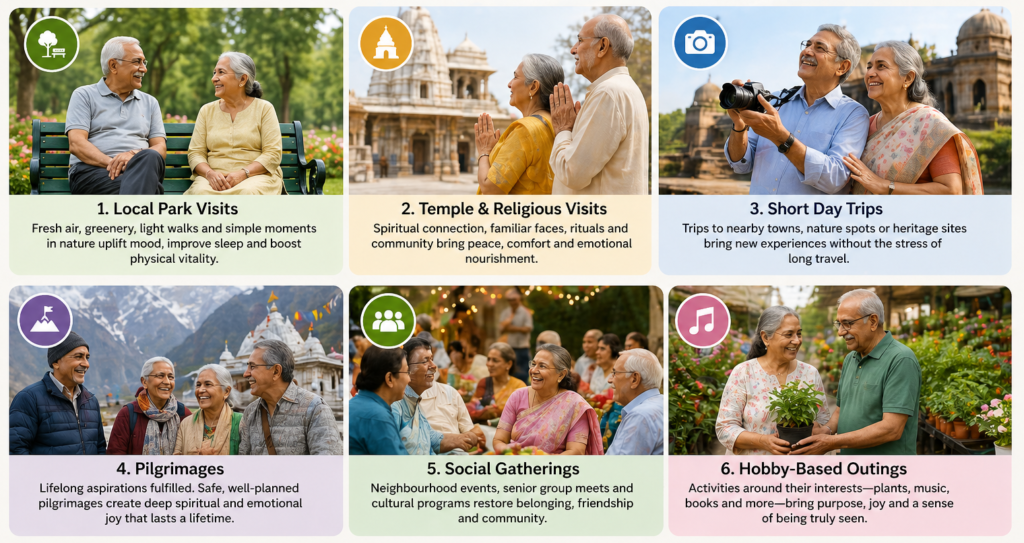
Not every outing needs to be elaborate to be valuable. The best outings are consistent, appropriately matched to the individual, and genuinely enjoyed — not endured.
Local park visits are among the most reliably beneficial outings for seniors at any mobility level. Fresh air, greenery, the sounds of life, light walking, and the simple pleasure of being outside — this is medicine for elderly parents who spend most of their hours indoors. Morning park visits, done regularly, can transform mood, sleep, and physical vitality.
Temple and religious visits carry enormous significance for most Indian seniors — not just spiritually but socially. The familiar faces at the neighbourhood mandir, the comfort of ritual, the sense of community, the peace of the space — a regular visit to a place of worship is one of the most nourishing outings possible for elderly parents.
Short day trips to familiar or meaningful places — a town they have always liked, a nature spot nearby, a heritage site with family significance — provide the cognitive and emotional benefits of travel without the demands of long journeys.
Pilgrimages represent a category of their own. For many Indian seniors, a pilgrimage is a lifelong aspiration — Char Dham, Vaishno Devi, Tirupati, Shirdi, Amritsar, Vrindavan. These are not holidays. They are deeply meaningful, profoundly personal journeys. Making them possible — safely, properly planned, with the right support — can be one of the most significant gifts a family gives to an elderly parent.
Social gatherings — attending a neighbour’s function, joining a senior group event, participating in a local cultural programme — restore the sense of community that isolation erodes. Being somewhere, with people, as a participant in life rather than a spectator.
Hobby-based outings — visiting a garden nursery with a parent who loves plants, attending a classical music performance for a parent who loves music, visiting a book fair for a lifelong reader — are among the most personally meaningful outings possible. They say: we see who you are. We are making space for what you love.
Signs Your Parents Need More Engagement
Sometimes families are not sure whether their parent is genuinely struggling. Here are the signs that suggest a senior needs more outings, more stimulation, and more engagement with the world outside their home.
Watch for a growing loss of interest in things your parent previously enjoyed — hobbies set aside, activities abandoned, topics they used to discuss with enthusiasm now met with indifference. Notice if your phone calls have become shorter and flatter — if your parent has less to say, seems less engaged, and conversations feel like check-ins rather than real connection.
Changes in appetite — eating less, skipping meals, losing weight — often accompany emotional withdrawal in seniors. So do disrupted sleep patterns, whether sleeping far too much or struggling to sleep at night. If your parent mentions feeling like a burden, expresses hopelessness, or seems persistently sad, these are serious signs that elderly wellbeing in India has declined and deserves immediate attention.
Increased forgetfulness or confusion — particularly if it has developed or worsened gradually — can be connected to reduced cognitive stimulation and social engagement.
None of these signs should be met with alarm — but all of them deserve a thoughtful, caring response. And a meaningful part of that response is ensuring your parent has more engagement with the world outside their home. IndiaRoots’ elderly care services in India are designed specifically to address these needs — consistently and compassionately.
How to Start: A Practical Approach
Beginning does not require grand plans or complicated arrangements. It requires starting.
Start with one outing per week. One consistent, anticipated, properly arranged outing — a park visit, a temple trip, a short excursion somewhere nearby. One outing per week, done reliably, creates the rhythm and anticipation that transforms wellbeing over time.
Begin with familiar, comfortable places. This is especially important for seniors who have become anxious about going out. The neighbourhood park is perfect. The local temple is ideal. Familiar environments feel safe, and safety is the foundation from which confidence grows.
Ensure accompaniment. Whether a trusted family member, a neighbour, or a professional companion — going out with someone is safer, more enjoyable, and more likely to actually happen than going alone.
Gradually expand. As confidence, habit, and comfort build — more ambitious outings become natural next steps. The local park becomes a day trip. The day trip becomes a pilgrimage. The pilgrimage becomes a journey your parent will talk about for years.
For families abroad, the most reliable path to making this happen consistently is partnering with a trusted assisted travel service for senior citizens in India that can arrange, accompany, and manage outings on your behalf — and keep you informed and connected throughout.
Your Parents Deserve a Life — Not Just Safety
We spend a great deal of effort, as caring families, ensuring our elderly parents are safe. That they have medicine. That the home is secure. That someone checks in.
Safety matters enormously. But it is not enough.
Your parents spent decades building a life — full of movement, relationships, experiences, purposes, and joys. They deserve the continuation of that life, not just its safekeeping. They deserve mornings with somewhere to go. Weeks with something to look forward to. Trips that become stories. Days that feel like living, not merely waiting.
Outings for elderly parents and senior citizen travel in India are not optional additions to a care plan. They are the difference between a parent who is alive and a parent who is truly living.
Dignity in old age is not just freedom from illness. It is the joy of a park at sunrise. The peace of a pilgrimage completed. The warmth of a festival celebrated. The pleasure of chai somewhere new, with someone kind beside you.
Your parents deserve all of that. Not someday. Now.
Help Your Parents Truly Live — Not Just Stay Home
At IndiaRoots, we don’t just arrange care — we bring life back into your parents’ daily routine.
From simple weekly outings to fully planned pilgrimages, we ensure your parents stay active, engaged, and emotionally fulfilled — with complete safety and real-time updates for you.
✔ Trusted companions for regular local outings
✔ Safe, fully managed senior citizen travel in India — including pilgrimages
✔ Personalised plans based on your parents’ needs, health, and interests
✔ Real-time updates, photos & reports after every outing
✔ Available across 30+ cities in India — trusted by 1,000+ NRI families globally
📞 Call / WhatsApp: +91 93508 98003 📧 info@indiaroots.org
👉 Book a Free Consultation Today
Ensure your parents don’t just stay at home — help them truly live.
IndiaRoots provides emotional wellbeing, companionship for seniors in India, and assisted travel services for senior citizens — trusted by NRI families from the USA, Canada, UK, Australia, UAE, and beyond.